
Quick Take
- what AI SEO means
- how it differs from traditional SEO
- what's actually working for search visibility in 2026
What You'll Learn
In this article you'll learn:
- What Is Traditional SEO?
- What Is AI SEO?
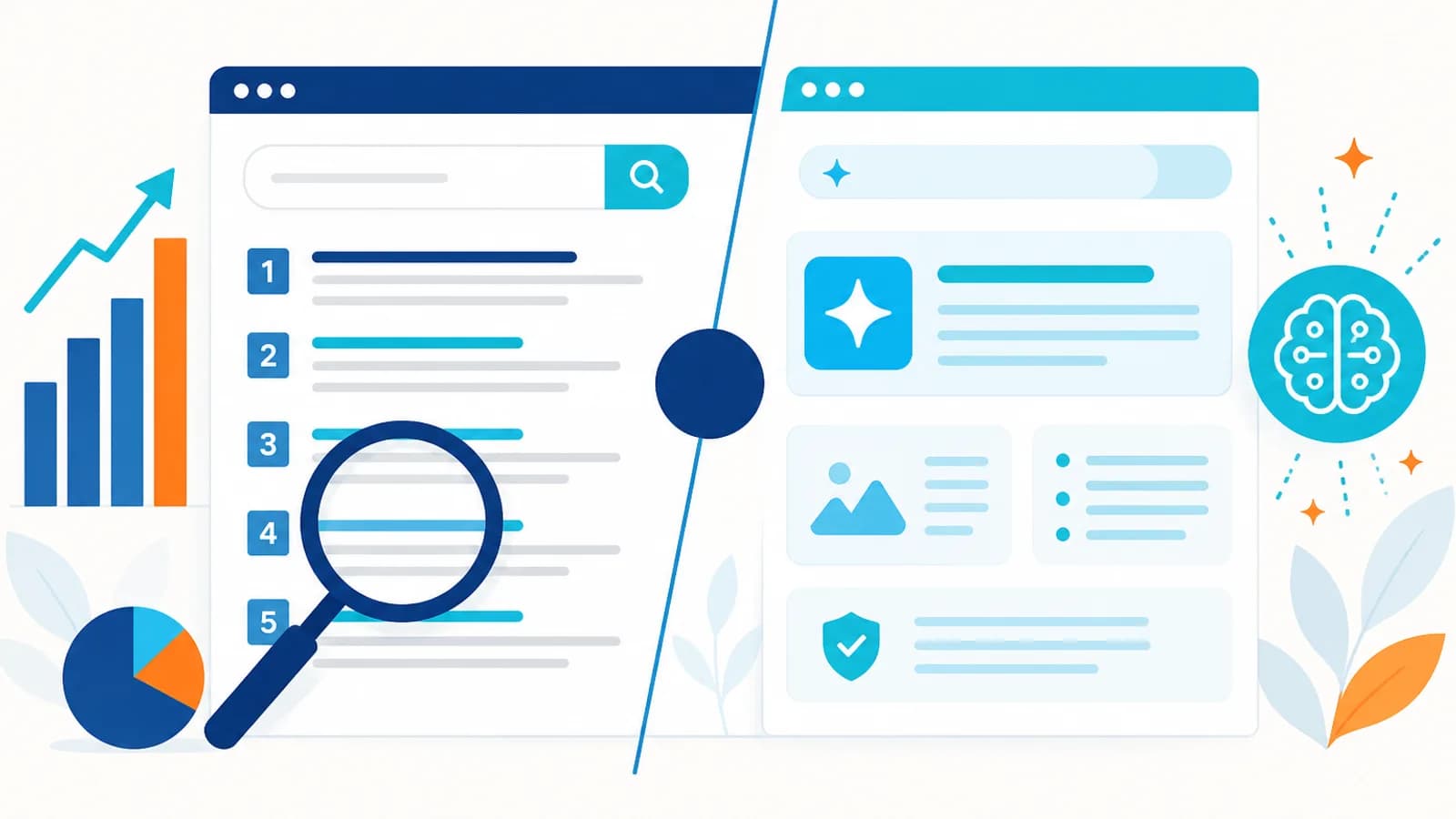
- Traditional SEO vs AI SEO
- Is Traditional SEO Still Working in 2026?
- What Is Actually Working in 2026?
- What Is Not Working as Well in 2026?
How This Works
Search visibility depends on clear content, technical foundations, and authority signals that help engines understand and recommend your pages.
How search visibility works
- Step 1: Content
- Step 2: Structure + intent
- Step 3: Crawl + index
- Step 4: Rank + cite
- Step 5: Qualified traffic
- Step 6: Business outcome
Need help improving digital visibility?
Improve Your Digital Visibility →SEO has changed dramatically. A few years ago, the formula seemed straightforward: find keywords → create content → optimize the page → build backlinks → rank on Google → get traffic. That approach still works. But the search landscape has changed.
Users are now asking AI-powered systems questions, comparing products through conversational interfaces, and looking for complete answers instead of simply browsing search results. Google is integrating AI into its search experience, while platforms such as ChatGPT and Gemini are becoming part of how people research information.
As a result, a new term has become increasingly popular: AI SEO. But what exactly does AI SEO mean? Is it replacing traditional SEO? Should businesses stop focusing on keywords? Do backlinks still matter? Does publishing AI-generated content improve rankings? And most importantly: What is actually working in SEO in 2026?
The answer is more practical than many AI SEO discussions suggest. Traditional SEO isn’t dead. AI SEO isn’t a replacement. The winning strategy is the combination of strong SEO fundamentals with content and digital strategies designed for an increasingly AI-driven search ecosystem.
What Is Traditional SEO?#
Traditional SEO focuses on improving a website’s visibility in conventional search engines. The core objective is: Search query → Search result → Website visit → Conversion.
Traditional SEO typically includes keyword research, search intent analysis, on-page optimization, technical SEO, internal linking, backlinks, content creation, page speed, mobile optimization, structured data, local SEO, and conversion optimization.
For example, a company offering CRM development might optimize a page for “Custom CRM Development Company.” The objective is to appear when someone searches for that service. Traditional SEO remains highly valuable because people continue to use conventional search engines for discovering products, services, companies, and information.
What Is AI SEO?#
AI SEO is a broader approach to optimizing a business’s online presence for AI-powered search and answer experiences. The terminology is still evolving. You may also see terms such as Generative Engine Optimization (GEO), Answer Engine Optimization (AEO), AI Search Optimization, LLM Optimization, and AI Search Visibility. These terms overlap, but they are not necessarily identical.
The common objective is: Make your business and content easy for AI systems to discover, understand, trust, and potentially reference when generating answers.
Instead of focusing exclusively on “Can I rank this page for this keyword?” AI-oriented optimization also asks: “Will my business be considered a useful source when someone asks an AI system this question?”
Traditional SEO vs AI SEO#
Traditional SEO’s primary objective is search rankings, with a main focus on keywords and pages, keyword-style searches, keyword-focused content, links and reputation for authority, and website clicks as the typical result. Optimization is often page-level.
AI SEO expands that objective to search + AI visibility. It focuses more on topics, entities, and answers; conversational questions; intent-led comprehensive content; links plus mentions, expertise, and entity signals; and results that may be answers, citations, recommendations, or clicks. Optimization becomes more ecosystem-level.
Content structure, original expertise, and brand visibility become even more important. AI citations become increasingly relevant, while technical SEO remains essential in both models. The key point is that there is significant overlap. Good AI SEO usually requires good traditional SEO.
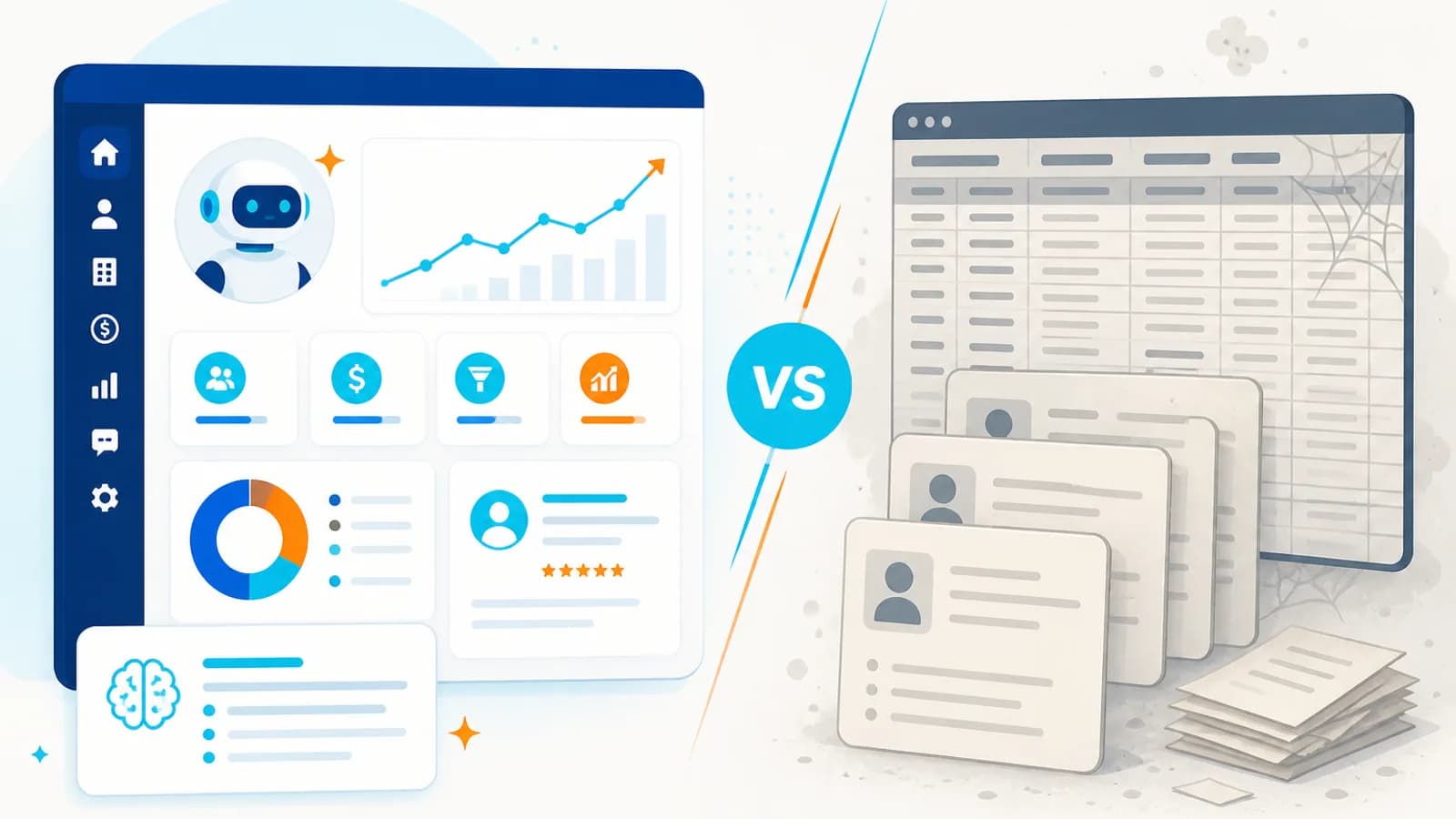
Effective SEO in 2026 combines traditional foundations with content structured for both search engines and AI-assisted discovery.
Before
- Keyword-focused pages
- Volume without depth
- Single search surface
- Rankings-only metrics
After AIOBook solution
- Intent-led content
- Original expertise
- Multi-surface visibility
- Conversion-aware measurement
Is Traditional SEO Still Working in 2026?#
Yes. This is one of the most important points businesses need to understand. Technical SEO, search intent, quality content, internal linking, site architecture, authority, relevant backlinks, and page experience still matter.
The difference is that these fundamentals now operate within a more complicated search environment. Think of traditional SEO as the foundation. AI SEO adds another layer on top.
What Is Actually Working in 2026?#
Let’s look at the strategies that businesses should prioritize.
1. Search Intent Is More Important Than Keyword Density#
One of the biggest changes in SEO is the declining importance of simply repeating a keyword. Suppose you want to rank for “AI CRM.” You could create an article that repeats AI CRM, AI-powered CRM, AI CRM software, and AI CRM platform over and over again. But that doesn’t necessarily make the article useful.
Instead, understand what someone searching for AI CRM actually wants to know—what it is, how it works, whether it’s better than traditional CRM, whether it can automate sales or integrate with WhatsApp, how much it costs, whether it’s suitable for small businesses, how secure it is, and whether AI can be integrated into an existing CRM.
This produces much stronger content. The winning principle is: Optimize for the question behind the keyword.
2. Topic Clusters Are More Valuable Than Random Blog Posts#
Publishing one article about a topic doesn’t establish expertise. Suppose your business specializes in AI automation. Instead of publishing random articles every week, create a structured topic cluster.
Start with a pillar such as “AI Business Automation: Complete Guide,” then support it with topics like What Are AI Agents?, AI Agents vs Traditional Automation, AI-Powered CRM, AI Customer Support, AI Sales Automation, AI Marketing Automation, AI Workflow Automation, AI Agent Architecture, AI Automation Security, and AI Automation ROI. Connect these articles using internal links.
Now your website isn’t simply publishing individual articles. It is building a knowledge ecosystem.
3. Original Content Is Becoming a Competitive Advantage#
AI has dramatically reduced the cost of producing generic content. Anyone can ask an AI system to write an article about CRM automation. The result may be technically correct—but hundreds of businesses can generate similar content. Generic content is becoming abundant. Original information is becoming more valuable.
Examples include original research, customer data, case studies, technical experiments, benchmarks, expert opinions, industry surveys, implementation lessons, and first-hand experiences. Instead of writing “AI can improve productivity,” show how: “After automating lead qualification, the sales team reduced manual lead-review time from approximately four hours per day to less than one hour.” Specific information is much more useful than generic claims.
4. First-Hand Experience Matters#
This is another area where businesses can differentiate themselves. Compare “Microservices improve scalability and flexibility” with: “We separated authentication, billing, reporting and notification workloads because each service had different scaling requirements. This allowed the reporting workload to scale independently without increasing infrastructure for transactional APIs.”
The second article demonstrates actual experience and provides something generic AI-generated content cannot easily provide: context. Businesses should document what they built, why they built it, what problems occurred, how they solved them, what trade-offs they made, and what results they achieved. That is valuable SEO content.
5. Brand Authority Is Becoming More Important#
SEO used to be heavily associated with individual pages. AI search increasingly requires businesses to think about the broader entity. An AI system may encounter your company through your website, LinkedIn, industry publications, business directories, reviews, partner websites, interviews, news articles, and communities.
The question becomes: Does the internet consistently describe this company as an expert in this subject? This is why businesses should build a consistent digital footprint.
6. Entity SEO Matters#
Search engines increasingly need to understand entities and relationships. For example: Company → Provides → AI CRM Development → For → B2B Businesses → Using → AI + Automation. Your website should make these relationships clear.
Don’t rely entirely on marketing phrases such as “We transform businesses through innovation.” Explain exactly what you do—for example: “We develop AI-powered CRM systems, workflow automation platforms, SaaS applications and custom enterprise software.” Clarity helps users and search systems understand the business.
7. Conversational Content Is Growing in Importance#
A traditional keyword might be “CRM automation.” A conversational query might be: “How can I automate lead qualification in my CRM without replacing my existing system?” The second query contains much more context.
Businesses should therefore create content that addresses natural questions. Useful formats include how-to guides, FAQs, comparisons, step-by-step tutorials, decision guides, troubleshooting guides, and case studies. Think beyond keywords. Think about conversations.
8. Comparison Content Is Extremely Valuable#
People increasingly use search to make decisions. They don’t just ask “What is AI CRM?” They ask “Should I use an AI CRM or traditional CRM?” or “Which CRM is best for my business?” This makes comparison content highly valuable.
Examples include AI CRM vs Traditional CRM, AI Agents vs Automation, RAG vs Fine-Tuning, Custom Software vs SaaS, Shopify vs WooCommerce, React vs Angular, and Cloud vs On-Premise. Good comparison content should explain use cases, benefits, limitations, cost, complexity, scalability, security, and best-fit scenarios. Don’t create fake comparisons simply to target keywords. Help the reader make a decision.
9. Internal Linking Still Works#
AI search doesn’t eliminate the importance of website architecture. If you publish an AI SEO Guide, it can link to GEO, AEO, AI Search, Technical SEO, Content Strategy, and Entity SEO. Likewise, those pages should link back to related content.
This creates a connected information architecture. Your website should increasingly behave like a well-organized knowledge base.
10. Technical SEO Still Matters#
AI doesn’t make technical SEO irrelevant. A website still needs to be crawlable, indexable, fast, mobile-friendly, secure, accessible, and properly structured. Important information shouldn’t be hidden exclusively inside complex interfaces if it needs to be discovered publicly.
Review robots.txt, XML sitemap, canonical URLs, redirects, broken links, JavaScript rendering, page speed, Core Web Vitals, mobile experience, and index coverage. AI search still needs access to information.
11. Structured Data Helps Clarify Content#
Structured data can provide additional context about a page. Depending on the website, relevant schema may include Organization, Article, Person, Product, Service, Breadcrumb, Local Business, and Review.
Structured data doesn’t guarantee rankings or AI citations. But it can help search engines interpret the information on your website. Use structured data accurately. Don’t mark up information that isn’t actually present on the page.
12. Backlinks Still Matter—But Quality Matters More Than Quantity#
AI SEO discussions sometimes claim that backlinks no longer matter. That’s an oversimplification. Relevant, authoritative references can still strengthen a website’s credibility.
But businesses should stop thinking “We need 1,000 backlinks.” Instead think: “Which trusted websites should reference our expertise?” Potential sources include industry publications, technology websites, research organizations, partner companies, professional associations, relevant blogs, interviews, and podcasts. One relevant authoritative reference can be more valuable than hundreds of irrelevant links.
13. Build Content That Can Be Quoted#
If you want your content to become a useful reference, make important information easy to extract. Use clear definitions, statistics, original findings, frameworks, tables, step-by-step processes, expert explanations, and strong conclusions.
For example, a simple AI automation decision framework: use traditional automation for predictable processes; use AI assistance for interpretation and recommendations; use AI agents for controlled, multi-step decision-making. A clear framework is easier for readers to remember and reference.
14. Don’t Publish Thousands of Low-Quality AI Articles#
AI makes content production faster. That doesn’t mean more content automatically means more traffic. Imagine two websites: Website A publishes 500 generic AI-generated articles. Website B publishes 50 highly researched articles with original examples, data, expertise and strong internal linking. Website B may have significantly stronger long-term value.
The competitive advantage is shifting from content volume to content quality + authority + usefulness.
15. AI Should Help Create Content—Not Replace Expertise#
AI can be extremely useful in an SEO workflow. Use it for topic research, keyword clustering, outlining, content briefs, summarization, content repurposing, internal-link suggestions, meta descriptions, content audits, and competitor analysis.
But humans should provide experience, opinions, validation, original examples, data, case studies, technical accuracy, and editorial judgment. The strongest model is AI-assisted + human expertise rather than AI-generated + human publishing button.
16. Optimize for Multiple Search Surfaces#
SEO is no longer limited to one search results page. Users may discover information through Google Search, Google AI experiences, ChatGPT, Gemini, YouTube, LinkedIn, Reddit, industry communities, news, podcasts, and social media. Your content strategy should therefore be designed for distribution, not just indexing.
For example, one pillar article can become website content, a Medium post, a LinkedIn article, a LinkedIn carousel, short-form posts, video, a newsletter, and community discussion. One strong piece of research can become an entire content ecosystem.
17. Don’t Ignore Conversion Optimization#
Getting visibility isn’t enough. Suppose your website receives 50,000 organic visitors but generates 20 qualified leads. Something is wrong. SEO should ultimately support business outcomes.
Improve calls to action, service pages, contact forms, lead magnets, demo requests, landing pages, trust signals, case studies, and testimonials. The objective is Search visibility → Qualified traffic → Leads → Revenue—not simply Search visibility → Traffic.
18. Measure More Than Rankings#
Traditional SEO dashboards often focus on keywords, rankings, impressions, clicks, and traffic. These remain useful. But businesses should also track brand searches, qualified leads, conversion rate, assisted conversions, revenue, referral traffic, brand mentions, AI visibility where measurable, and content engagement.
The question should be: Is our search strategy creating business value?
What Is Not Working as Well in 2026?#
Several old SEO habits are becoming increasingly weak. Keyword stuffing doesn’t create useful content. Thin content created solely to target a keyword is unlikely to compete against comprehensive resources consistently. Mass AI content isn’t a substitute for expertise. Irrelevant backlinks don’t create meaningful authority.
Clickbait is useless if visitors immediately leave because the content doesn’t satisfy their intent. Fake expertise without evidence is easy to reproduce. And creating content without distribution is no longer enough for many competitive topics.
The New SEO Formula#
A useful way to think about SEO in 2026 is: Technical Foundation + Search Intent + High-Quality Content + Topical Authority + Original Expertise + Entity Clarity + Relevant Authority + Distribution + Conversion Optimization = Search Visibility + Business Growth.
AI SEO doesn’t eliminate the traditional SEO foundation. It expands it.
AI SEO vs Traditional SEO: Which Should Businesses Choose?#
The answer is both. Don’t abandon traditional SEO. Instead, evolve it.
Traditional SEO should handle technical SEO, crawlability, indexing, site architecture, keywords, search intent, internal linking, backlinks, and page optimization.
AI-oriented SEO should add conversational questions, topical authority, entity optimization, original research, first-hand experience, structured information, AI-search visibility, brand authority, and multi-platform content distribution. The two strategies complement each other.
Effective SEO in 2026 combines traditional foundations with content structured for both search engines and AI-assisted discovery.
Before
- Keyword-focused pages
- Volume without depth
- Single search surface
- Rankings-only metrics
After AIOBook solution
- Intent-led content
- Original expertise
- Multi-surface visibility
- Conversion-aware measurement
A Practical 2026 SEO Framework#
Stage 1 — Build the Foundation: Audit technical SEO, site structure, indexability, page speed, mobile usability, and internal linking.
Stage 2 — Understand the Audience: Identify problems, questions, search intent, buying decisions, objections, and comparison queries.
Stage 3 — Build Topic Authority: Create pillar pages, supporting articles, service pages, comparison content, case studies, and FAQs.
Stage 4 — Establish Authority: Develop original research, expert authorship, relevant backlinks, industry mentions, partnerships, and digital PR.
Stage 5 — Measure and Improve: Track rankings, traffic, leads, conversions, revenue, brand searches, and AI visibility where measurable—then continuously improve.
The Future: SEO Becomes Search Visibility Optimization#
The biggest change isn’t that SEO is disappearing. It is that search itself is expanding. Your customer may discover your business through a Google search today. Tomorrow they may ask an AI assistant. Next week they may see a LinkedIn post. Another customer may find your company through a YouTube video or industry publication.
All of these are part of the modern discovery journey. Therefore, businesses should think beyond “How do we rank this page?” and start thinking: “How do we become visible and trusted wherever our customers search for answers?”
Final Thoughts#
AI SEO isn’t a magic replacement for traditional SEO. There is no secret technique that guarantees that ChatGPT, Gemini, or Google’s AI systems will mention your website. And businesses shouldn’t build their strategy around chasing algorithms.
The fundamentals remain surprisingly consistent: help people, answer real questions, demonstrate expertise, create original information, build authority, make your website technically accessible, connect your content, build a recognizable brand, and measure business outcomes.
The difference in 2026 is that these principles now need to work across a much broader search ecosystem. Traditional SEO helps your website become discoverable. AI-oriented SEO helps your content become understandable and useful within conversational search. Brand building establishes trust. Original expertise gives people—and potentially AI systems—a reason to reference you. And strong conversion optimization turns visibility into business.
So, what is actually working in 2026? Not AI SEO instead of traditional SEO. Not traditional SEO instead of AI SEO. The winning approach is: Technical SEO + Search Intent + Topical Authority + Original Expertise + Brand Authority + AI Search Visibility + Conversion Optimization.
SEO is not becoming less important. The definition of search is becoming bigger. And businesses that adapt their strategy accordingly will be better positioned to compete for attention, trust, and customers in the years ahead.
How This Benefits an Organization
The answer is both. Don’t abandon traditional SEO. Instead, evolve it.
- More qualified discovery
- Stronger content structure
- Better crawlability
- Improved trust signals
You May Also Like
How to Get Your Website Cited by ChatGPT, Gemini & Google AI in 2026
10 August 2026
How AI Search Is Changing SEO in 2026
10 August 2026
AI Agents vs Traditional Automation: What Businesses Should Choose in 2026?
10 August 2026
AI-Powered CRM: Why Traditional CRMs Are Becoming Outdated in 2026
10 August 2026