
Quick Take
- Traditional automation remains best for predictable, rule-based workflows.
- AI agents add value when processes need language, context, or adaptation.
- Hybrid architectures often combine reasoning with reliable execution.
- Choose technology based on the business process — not the trend.
What You'll Learn
In this article you'll learn:
- What Is Traditional Automation?
- What Are AI Agents?
- AI Agents vs Traditional Automation
- When Traditional Automation Is Better
- When AI Agents Make More Sense
- The Real Winner: Hybrid Automation
How This Works
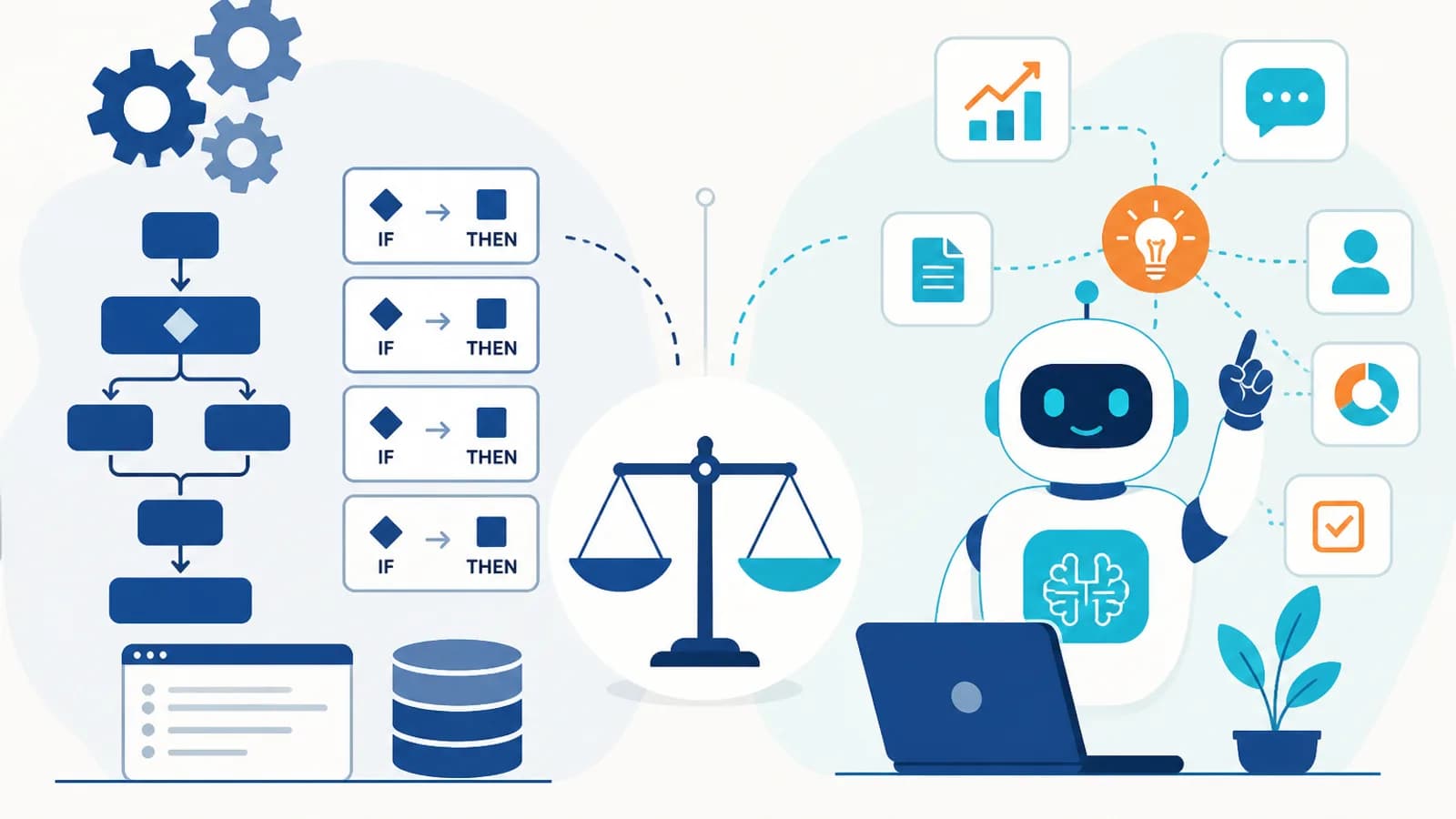
The decision is not AI versus automation — it is which parts of a process need intelligence versus reliable execution.
Problem
Teams must choose between rule-based automation and AI agents for each process.
Approach
Map predictability, context, risk, and business value before selecting technology.
Solution
Use automation for deterministic steps and AI where interpretation adds value.
Integration
Hybrid architectures connect AI reasoning to CRM, ERP, and automation layers.
Outcome
Reliable execution with intelligence where it matters.
- Problem
- Teams must choose between rule-based automation and AI agents for each process.
- Approach
- Map predictability, context, risk, and business value before selecting technology.
- Solution
- Use automation for deterministic steps and AI where interpretation adds value.
- Integration
- Hybrid architectures connect AI reasoning to CRM, ERP, and automation layers.
- Outcome
- Reliable execution with intelligence where it matters.
AI agents vs traditional automation is no longer just a technology debate. It is a business decision.
For years, businesses have relied on traditional automation to reduce repetitive work. A workflow receives an input, follows predefined rules, performs a series of actions, and produces an output. That approach still works extremely well.
But businesses now have another option: AI agents. AI agents can understand natural language, reason through problems, make decisions, use tools, retrieve information, and adapt their actions based on the situation.
So, the question businesses should be asking in 2026 is not: “Are AI agents better than automation?” It is: “Which business processes should use traditional automation, AI agents, or a combination of both?” The answer depends on the complexity, predictability, risk, and business value of the process.
What Is Traditional Automation?#
Traditional automation is based primarily on predefined rules and workflows. A typical workflow looks like: Trigger → Rule → Action → Result.
For example: a customer submits a form; the system validates the information; the lead is added to the CRM; an email is sent; and the sales team receives a notification. The workflow knows exactly what to do because the business has already defined the rules.
Popular technologies used for traditional automation include workflow automation platforms, APIs, webhooks, RPA, cron jobs, database triggers, business rules engines, ETL pipelines, and integration platforms.
Traditional automation is particularly powerful when the process is structured, repetitive, and predictable.
What Are AI Agents?#
AI agents take automation a step further. Instead of only following predefined instructions, an AI agent can understand natural language, analyze information, make decisions, use external tools, retrieve information from databases, call APIs, remember relevant context, plan multiple steps, adapt its actions based on results, and escalate complex situations to humans.
A simplified AI agent workflow can look like: Goal → Understand → Reason → Plan → Use Tools → Evaluate → Act.
For example, imagine a sales inquiry: “I have a budget of ₹5 lakh and want a website and CRM for my education consultancy. Can you recommend what I need?” A traditional workflow may struggle because the input doesn’t perfectly match predefined fields.
An AI agent can interpret the request, identify the customer’s requirements, retrieve relevant services and pricing, ask follow-up questions, and potentially create a qualified lead in the CRM. That is the fundamental difference.
AI Agents vs Traditional Automation#
Traditional automation
Best for:
- Predictable
- Repetitive
- Rule-based
- High-volume
- Auditable
AI agents
Best for:
- Dynamic
- Contextual
- Natural language
- Decision-oriented
- Unstructured
Hybrid
Best for:
- Reasoning + execution
- Complex workflows
- Enterprise systems
- Human oversight
| Capability | Traditional automation | AI agents | Hybrid |
|---|---|---|---|
| Rule-based tasks | Excellent | Good | Excellent |
| Predictable processes | Excellent | Good | Excellent |
| Structured data | Excellent | Good | Excellent |
| Natural language | Limited | Excellent | Excellent |
| Decision-making | Predefined rules | Context-aware | Balanced |
| Adaptability | Low | High | High |
| Complex workflows | Difficult | Strong | Strong |
| Tool / API usage | Excellent | Excellent | Excellent |
| Human-like interaction | Limited | Strong | Strong |
| Governance | Easier | Requires controls | Structured |
| Cost predictability | High | Variable | Mixed |
| Best fit | Repetitive processes | Dynamic processes | Reasoning + execution |
Capability comparison at a glance: Rule-based workflows — both are excellent. Repetitive tasks — both are excellent. Structured data — traditional automation is excellent; AI agents are good. Unstructured data and natural language — traditional automation is limited; AI agents are excellent.
Decision-making in traditional automation relies on predefined rules, while AI agents are context-aware. Adaptability is low for traditional automation and high for AI agents. Predictability is very high for traditional automation and medium to high for AI agents.
Complex workflows can become difficult with traditional automation and are often better suited to AI agents. Tool and API usage is excellent for both. Human-like interaction is limited in traditional automation and strong with AI agents. Governance is easier with traditional automation and requires stronger controls for AI agents. Cost predictability is high for traditional automation and more variable for AI agents.
Best fit: traditional automation for repetitive processes; AI agents for dynamic processes. The important point is that AI agents do not replace traditional automation. In many businesses, the best architecture will use both.
When Traditional Automation Is Better#
- • Structured inputs
- • Predictable outcomes
- • Stable rules
- • High-volume repetitive work
- • Strong audit requirements
AI is not the answer to every problem. If a process is deterministic, there is often little reason to introduce an AI model.
Example: invoice processing. Suppose your business receives a structured invoice. The workflow is: Invoice received → Validate fields → Store invoice → Update accounting system → Send confirmation. There is no significant reasoning requirement.
Traditional automation is usually the better choice because it is faster, more predictable, lower in operational cost, easier to test, easier to monitor, and easier to audit. Adding an AI agent simply because AI is trending could actually make the system unnecessarily complicated.
When AI Agents Make More Sense#
- • Unstructured information
- • Natural language
- • Contextual decisions
- • Changing conditions
- • Multi-step reasoning
AI agents become more valuable when the process involves unstructured information, decisions, ambiguity, or changing conditions.
Consider customer support. A customer might say: “My payment went through yesterday, but my subscription is still showing as inactive. I already tried logging out and logging back in.” A traditional workflow needs many predefined conditions to handle different variations.
An AI agent can understand the request, identify the likely problem, check the customer’s subscription status, review payment information, investigate available knowledge, and determine the appropriate next step — then either resolve the issue or escalate it to a human.
This makes AI agents particularly useful for customer support, sales qualification, research, content operations, document analysis, knowledge management, troubleshooting, personalized recommendations, business intelligence, and complex internal workflows.
The Real Winner: Hybrid Automation#
Hybrid automation uses AI for interpretation and decision-making, then triggers reliable execution in connected enterprise systems.
- Step 1: AI interpretation
- Step 2: Decision
- Step 3: API
- Step 4: Traditional automation
- Step 5: Enterprise system
One of the biggest mistakes businesses can make in 2026 is treating AI agents and automation as competing technologies. They are often better together.
Consider an e-commerce business. A customer asks: “Can you find me a laptop under ₹70,000 suitable for software development?” An AI agent can understand the request, identify requirements, search the product database, compare products, consider specifications, and recommend suitable options.
But once the customer chooses a product, traditional automation can take over: AI Agent → Product selected → API → Order created → Payment → Inventory updated → Email → CRM. Here, AI handles reasoning while traditional automation handles execution. This is often the most practical architecture.
A Simple Decision Framework#
Before implementing an AI agent, ask these five questions.
1. Is the process predictable? If the same input should always produce the same result, traditional automation may be sufficient.
2. Does the process require interpretation? If employees need to read emails, documents, conversations, or natural-language requests before deciding what to do, AI can add significant value.
3. Does the process require decisions? If the workflow needs contextual decisions rather than simple if/else rules, an AI agent may be appropriate.
4. What happens if the system makes a mistake? For low-risk activities such as drafting an email, AI can operate with more freedom. For high-risk activities such as financial transactions, legal decisions, or critical infrastructure, businesses need stronger controls, validation, and human oversight.
5. Is AI actually providing measurable value? The objective should not be “We need an AI agent.” The objective should be “We need to reduce processing time, increase conversion, reduce operational cost, or improve customer experience.” Technology should follow the business objective.
Should Your Business Use AI Agents or Automation?
Use this decision path to evaluate whether automation, AI agents, or a hybrid model fits the process.
1. Is the process predictable?
- Yes: Traditional automation may be sufficient.
- No: Continue evaluating contextual requirements.
2. Does it require contextual understanding?
- Yes: An AI agent may add value.
- No: Traditional automation is usually preferable.
3. Does AI need to trigger deterministic actions?
- Yes: Hybrid AI + automation architecture.
- No: Evaluate based on risk and business value.
Use these five questions to evaluate whether traditional automation, AI agents, or a hybrid approach fits your process. The interactive tool below follows the same framework.
Question 1: Is the process predictable?
- Yes: Traditional Automation may be sufficient. → Traditional Automation
- No: Continue to the next question.
Question 2: Does the process require interpreting natural language, documents, or conversations?
- Yes: AI may add value.
- No: Continue to the next question.
Question 3: Does the process require contextual decision-making?
- Yes: An AI Agent may be appropriate — continue evaluating risk and value.
- No: Traditional Automation is usually preferable. → Traditional Automation
Question 4: What happens if the system makes a mistake?
- Low risk: More autonomy may be possible.
- High risk: Stronger controls and human oversight are required.
Question 5: Does AI create measurable business value?
- Yes: Evaluate implementation — hybrid architectures often fit best.
- No: Do not add AI simply because it is available.
Interactive decision tool
Step 1 of 5
Is the process predictable?
Where Businesses Can Use AI Agents in 2026#
Sales
- AI role
- Understand inquiry, qualify lead, research prospect
- Automation role
- Create CRM record, send notification, schedule follow-up
- Potential architecture
- AI qualification → CRM automation → notifications
Customer support
- AI role
- Interpret request, search knowledge, troubleshoot
- Automation role
- Create ticket, update CRM, send confirmations
- Potential architecture
- AI support agent → ticket workflow → escalation rules
Marketing
- AI role
- Research topics, draft content, analyze responses
- Automation role
- Schedule posts, route approvals, publish assets
- Potential architecture
- AI content assist → approval workflow → publishing
Finance
- AI role
- Analyze documents, categorize expenses, flag anomalies
- Automation role
- Store records, reconcile payments, update ERP
- Potential architecture
- AI document analysis → deterministic accounting steps
Human resources
- AI role
- Screen candidates, answer FAQs, process documents
- Automation role
- Schedule interviews, route onboarding tasks
- Potential architecture
- AI screening assist → workflow automation with human review
Sales: An AI sales agent can capture leads, understand requirements, qualify prospects, research companies, recommend services, update CRM records, schedule meetings, and generate follow-ups.
Customer support: AI agents can understand customer questions, search the knowledge base, retrieve account information, troubleshoot issues, create support tickets, and escalate complex cases.
Marketing: AI agents can research topics, generate content ideas, analyze campaigns, create social media drafts, repurpose content, and analyze audience responses.
Finance: AI-powered workflows can assist with invoice processing, expense categorization, financial document analysis, payment reconciliation, and reporting. Traditional automation can then execute the deterministic parts of these workflows.
Human resources: AI agents can assist with candidate screening, interview scheduling, employee FAQs, document processing, and onboarding workflows. Sensitive employment decisions should have appropriate human oversight.
The Cost Question#
One reason businesses should not immediately replace automation with AI agents is cost. Traditional automation generally has predictable execution costs.
AI-based systems can introduce additional costs through model usage, API calls, vector databases, tool execution, infrastructure, observability, evaluation, and human review. Therefore, businesses should evaluate the total cost of ownership, not simply the cost of building the initial workflow.
For a simple workflow that costs ₹1 to automate conventionally, spending significantly more to introduce AI may not make business sense. But if an AI agent can save employees several hours every day or significantly improve conversion, the economics can become very different.
What Does AI Automation Actually Cost?
- Model usage
- API calls
- Vector database
- Tool execution
- Infrastructure
- Observability
- Evaluation
- Human review
- Maintenance
How Should Businesses Measure AI Automation?
AI adoption should be measured against the business outcome it is intended to improve.
- • Processing time
- • Cost per transaction
- • Employee hours saved
- • Conversion rate
- • Response time
- • Error rate
- • Customer satisfaction
- • Revenue impact
AI Agents Also Introduce New Risks#
AI agents provide greater flexibility, but flexibility requires control. Businesses need to consider security (what systems the agent can access), permissions (what actions it is allowed to perform), and data privacy (what customer or business information is being processed).
They also need to address hallucinations (what happens if the model generates an incorrect answer), monitoring (can the business see what the agent is doing), human escalation (when should the agent stop and ask a human), and auditability (can decisions and actions be traced).
For production AI systems, these questions are just as important as the AI model itself.
- Security
- Permissions
- Privacy
- Hallucinations
- Monitoring
- Human escalation
- Auditability
- Data governance
What Happens When the AI Makes a Mistake?
Production systems need validation, permission boundaries, human review, fallback workflows, and logging so mistakes can be detected, contained, and corrected.
A Better Enterprise Architecture#
A mature business automation architecture in 2026 will increasingly look like this: User / Customer → AI Interface → AI Agent / Agent Orchestrator → Knowledge + Business Context → Tools / APIs / Databases → Traditional Automation → Enterprise Systems.
The AI layer handles interpretation and decision-making. The automation layer handles reliable execution. Enterprise systems remain the source of truth.
This separation creates a much more controllable architecture than trying to make an AI agent responsible for everything.
The Practical Enterprise Architecture
AI handles interpretation and reasoning. Traditional automation handles deterministic execution. Enterprise systems remain the source of truth. Human oversight provides validation, escalation, and governance.
Enterprise AI + automation architecture
- Step 1: User / Customer
- Step 2: AI Interface
- Step 3: AI Agent / Orchestrator
- Step 4: Knowledge + Business Context
- Step 5: Tools / APIs / Databases
- Step 6: Traditional Automation
- Step 7: CRM / ERP / Enterprise Systems
- Step 8: Human Oversight
AI Agent or Automation? Use This Rule#
Use traditional automation when the process is predictable + repetitive + rule-based.
Use AI agents when the process is dynamic + contextual + decision-oriented.
Use both when the process requires reasoning followed by reliable execution. This third category is likely to become the most important one for businesses adopting AI.
What Should Businesses Do in 2026?#
Don’t start by asking “Where can we use AI?” Start by mapping your business processes. For every process, identify input, decision points, human involvement, repetitive activities, data sources, existing systems, business risks, processing time, cost, and expected outcome.
Then classify each process as Automate, Augment, or Agentify.
Automate: use traditional automation for deterministic processes. Augment: use AI to assist employees while humans remain responsible for decisions. Agentify: use AI agents where autonomous reasoning can create meaningful business value and appropriate controls are in place.
Automate
Use traditional automation.
Best for: Deterministic tasks with stable rules.
Augment
Use AI to assist employees.
Best for: Decision support with human accountability.
Agentify
Use AI agents for autonomous workflows.
Best for: Dynamic processes with appropriate controls.
Final Thoughts#
The future of business automation isn’t AI agents replacing automation. It is the combination of AI reasoning + traditional automation + enterprise systems + human oversight.
Traditional automation remains the foundation for reliable, repeatable execution. AI agents add a new layer of intelligence that can understand context, reason about problems, and determine what should happen next.
The businesses that benefit most from AI in 2026 will not necessarily be the businesses using the most AI. They will be the businesses that know where AI is useful, where deterministic automation is better, and where the two should work together.
The question isn’t “Should we choose AI agents or traditional automation?” The better question is: “Which parts of our business need intelligence, and which parts simply need reliable execution?” That is where the real opportunity lies.
Looking Ahead#
As AI systems become more capable, businesses will increasingly move from simple task automation toward AI-powered business processes.
But successful adoption will depend on more than connecting an AI model to a workflow. It will require thoughtful architecture, secure integrations, reliable data, observability, evaluation, governance, and clear business objectives.
AI should not replace good processes. It should make good processes more intelligent, scalable, and efficient.
If you need help choosing an architecture, AIOBook delivers AI agent development services, AI automation services, n8n automation services, and custom software development based on the process — not the trend.
How This Benefits an Organization
The technology decision should depend on how predictable the process is, the level of human judgment required, and the consequences of an incorrect decision.
- Clearer technology decisions per process
- Less unnecessary AI complexity
- Better governance and oversight
- Connected reasoning and execution
Frequently Asked Questions
Are AI agents better than traditional automation?
Not universally. Traditional automation is often better for predictable, rule-based processes. AI agents add value when processes involve unstructured information, contextual decisions, or changing conditions.
When should a business use traditional automation?
When inputs and outputs are structured, rules are stable, volume is high, and auditability and predictability matter more than interpretation.
When should a business use AI agents?
When the process requires natural language, document interpretation, contextual decision-making, or adaptation to changing conditions.
Can AI agents and automation work together?
Yes. Hybrid architectures use AI for reasoning and interpretation, then traditional automation for reliable execution in CRM, ERP, and other enterprise systems.
Are AI agents more expensive?
They can be. AI systems may add model usage, API, vector database, observability, evaluation, and human review costs compared with predictable rule-based automation.
What risks do AI agents introduce?
Security, permissions, privacy, hallucinations, monitoring gaps, and auditability challenges. Production systems need validation, escalation paths, and human oversight.
How should businesses evaluate AI automation ROI?
Measure against the business outcome the workflow is meant to improve — such as processing time, cost per transaction, conversion, response time, error rate, or employee hours saved.
Can existing CRM and ERP systems work with AI agents?
Yes. AI agents typically connect through APIs and tools to existing CRM, ERP, and databases while automation handles deterministic updates to those systems.
You May Also Like
How Businesses Can Automate Their Entire Workflow Using AI Agents in 2026
10 August 2026
n8n + AI Agents: 10 Business Processes You Can Automate in 2026
10 August 2026
How to Build an AI Customer Support Agent for Your Business in 2026
10 August 2026
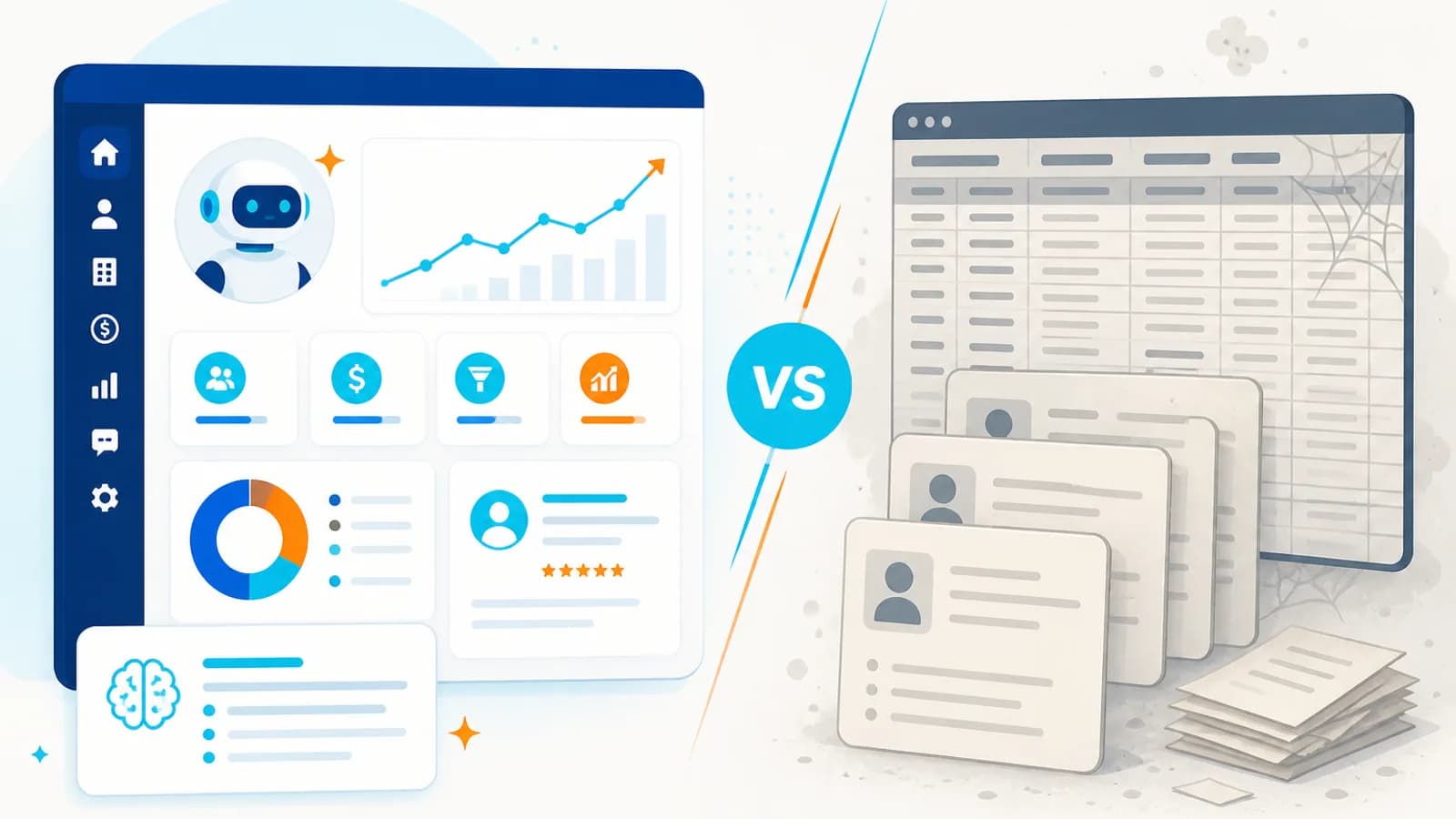
AI-Powered CRM: Why Traditional CRMs Are Becoming Outdated in 2026
10 August 2026