Education
Typical problem: Lead and student lifecycle spread across tools
Potential solution: CRM, portals, and workflow automation
Explore Education →Generic AI answers are not enough for enterprise work. AIOBook builds RAG applications, knowledge bases and private AI chatbots grounded in your documents, policies and systems.
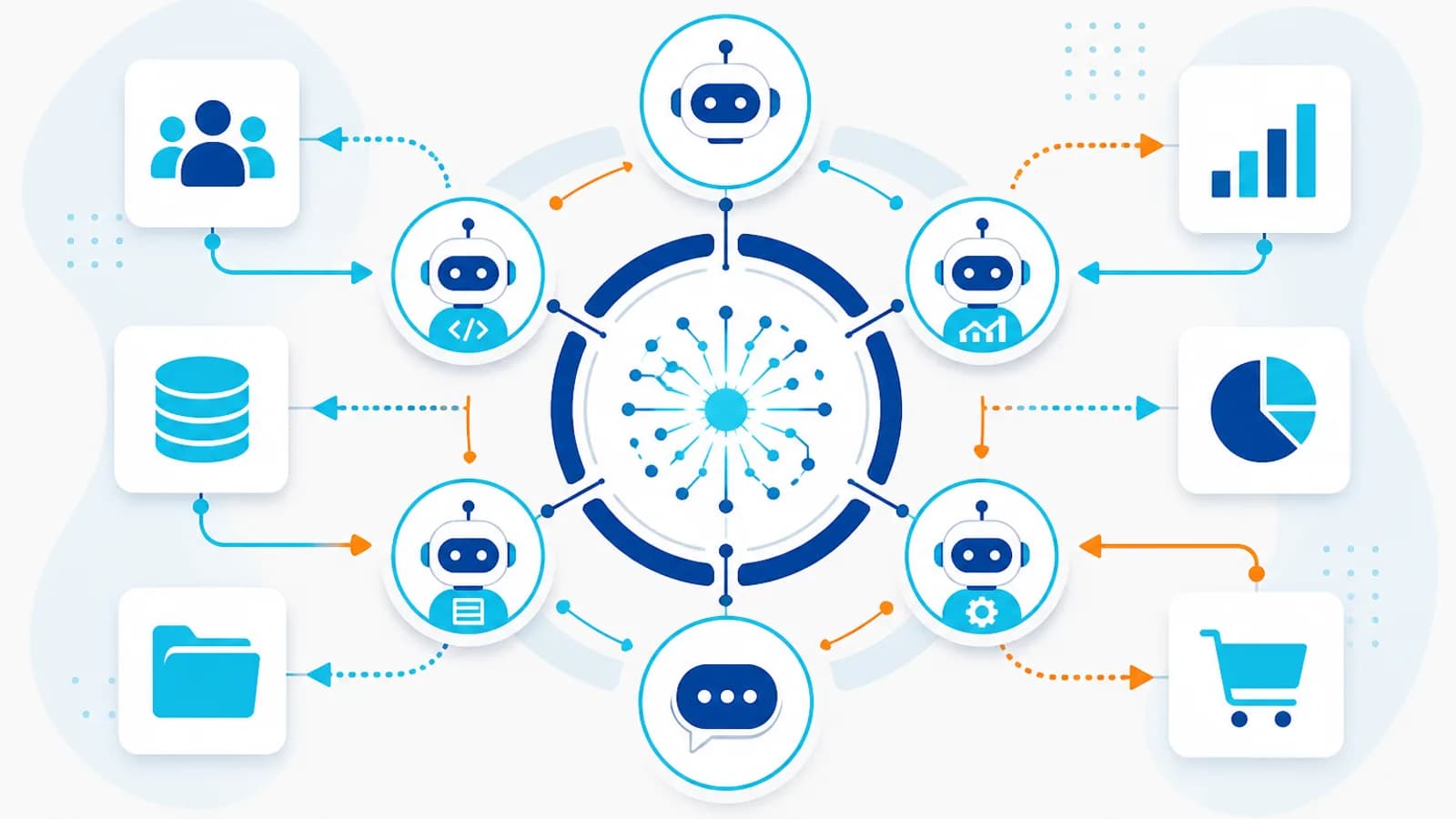
RAG (Retrieval-Augmented Generation) retrieves relevant business content before generating answers, so responses stay grounded in your knowledge. AIOBook builds RAG chatbots, enterprise search, document intelligence and private AI assistants with access controls and integrations.
The comparison below shows common operational friction before a connected solution — and the direction AIOBook solutions aim to achieve.
Before
After AIOBook solution
AIOBook starts from the business problem, then designs technology and integrations that support reliable execution.
Problem
Answers must reflect proprietary, up-to-date business knowledge.
Approach
Ingest documents, retrieve relevant chunks, generate grounded answers, evaluate quality.
Solution
LLMs, vector search, RAG pipelines, access controls and evaluation.
Integration
Knowledge bases, portals, CRM and support systems.
Outcome
Accurate, citable AI answers tied to your content.
The system retrieves relevant documents, ranks context, generates an answer grounded in that content, and can optionally trigger business actions through connected systems.
Have a similar process in your organization?
Discuss Your Requirement →RAG systems create more value when connected to the channels and systems teams already use.
Where appropriate, AIOBook connects the solution with existing business systems through APIs and integrations.
Typical problem: Lead and student lifecycle spread across tools
Potential solution: CRM, portals, and workflow automation
Explore Education →Typical problem: Patient coordination and manual intake workflows
Potential solution: Portals, automation, and connected systems
Explore Healthcare →Typical problem: Inventory, orders, and customer data out of sync
Potential solution: E-commerce, CRM, and operational automation
Explore Retail →Typical problem: Lead follow-up and listing workflows
Potential solution: CRM and custom workflow tools
Explore Real Estate →Typical problem: Client delivery and billing disconnected from sales
Potential solution: CRM and custom applications
Explore Professional Services →Implementation moves from consultation through design, build, integration, testing, launch, and optimization.
Generic implementation
AIOBook approach
Technology
Challenge: Support teams spent hours on repetitive tickets and manual summaries.
Solution: AI-assisted support with suggested replies, triage, and knowledge retrieval.
Outcome: Lower handle times and improved first-contact resolution.
Finance
Challenge: Claims intake and document verification created long processing backlogs.
Solution: Claims portal with document upload, AI-assisted triage, and status tracking.
Outcome: Faster first response and reduced manual document handling.
RAG retrieves relevant business content before generating an answer, keeping responses grounded in your documents instead of only model memory.
RAG is usually best when answers must reflect proprietary or frequently updated documents. Fine-tuning can help with style or specialized language.
Yes. RAG is commonly used for support assistants that answer from approved knowledge bases with escalation to humans.
Build AI agents that interpret requests, use tools and automate multi-step workflows.
Best for
Organizations needing intelligent automation beyond simple chatbots
Benefit
Faster process execution with controllable AI agents
Explore AI Agent DevelopmentAutomate leads, support, CRM updates, documents and business workflows with AI.
Best for
Teams with repetitive processes and unstructured inputs
Benefit
Less manual work and more consistent operations
Explore AI AutomationBuild software tailored to workflows that do not fit generic tools.
Best for
Organizations with unique processes or data models
Benefit
Software that matches how the business actually works
Explore Custom ApplicationsCentralize leads, pipelines, and customer history.
Best for
Organizations with scattered customer data and sales workflows
Benefit
Better sales visibility and consistent follow-up
Explore CRM SolutionsTell us what you're trying to improve, automate or build. We can help you identify the right approach and next step.