
Quick Take
- What Is AI Automation for Education Consultants?
- Why Education Consultancies Need AI Automation
- The Student Journey
- Traditional Education Consultancy vs AI-Powered Consultancy
What You'll Learn
In this article you'll learn:
- What Is AI Automation for Education Consultants?
- Why Education Consultancies Need AI Automation
- The Student Journey
- Traditional Education Consultancy vs AI-Powered Consultancy
- The Role of AI Agents
- Why You Shouldn’t Build Too Many Agents
How This Works
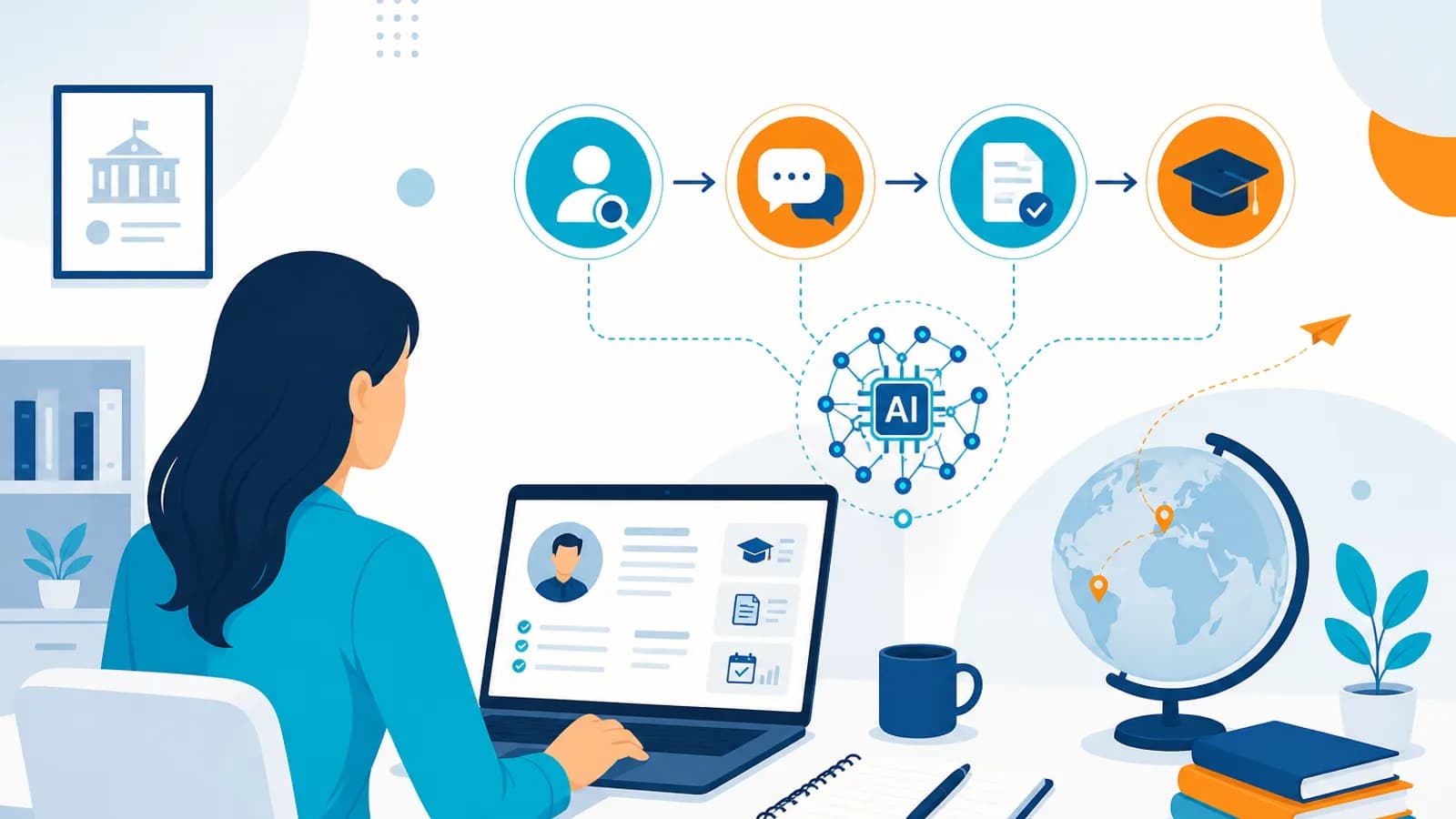
Education consultancies benefit when lead capture, student data, counselling, and application tracking connect in one workflow.
Education consultancy workflow
- Step 1: Lead captured
- Step 2: Student profile
- Step 3: AI-assisted counselling
- Step 4: Document processing
- Step 5: Application tracking
- Step 6: Counsellor review
- Step 7: Enrollment outcome
Running an education consultancy?
Discuss Your Workflow →The education consultancy industry is becoming increasingly digital. Students discover universities online, submit inquiries through websites and social media, communicate through WhatsApp, attend counselling sessions remotely, compare courses, and expect quick responses throughout their journey.
For education consultants, this creates both an opportunity and a challenge. More leads can mean more business. But more leads also mean more follow-ups, more counselling conversations, more documents, more applications, more communication, more data entry, more coordination, and more reporting.
Many education consultancies still manage these activities using spreadsheets, email, WhatsApp, disconnected CRM systems, and manual processes. The result is often the same: leads are missed, follow-ups are delayed, counsellors spend time on administration, managers lack real-time visibility, and students receive inconsistent communication.
This is where AI automation for education consultants can make a significant difference. Instead of simply automating individual tasks, education businesses can build connected workflows that use AI to understand student information, assist counsellors, automate communication, manage applications, and provide management insights. The goal isn’t to replace counsellors. The goal is to give counsellors an intelligent system that helps them work faster and provide a better student experience.
What Is AI Automation for Education Consultants?#
AI automation combines Artificial Intelligence + Workflow Automation + CRM + Business Data + Integrations to automate and assist with repetitive education consultancy processes.
A traditional workflow might look like: Student Inquiry → Employee Reviews → Employee Enters CRM → Employee Calls → Employee Updates Notes → Employee Schedules Follow-Up. An AI-powered workflow can become: Student Inquiry → AI Understands Profile → CRM Updated → Lead Qualified → Counsellor Assigned → Personalized Communication → Follow-Up Automated. The counsellor remains involved—but much of the repetitive administrative work is handled automatically.
Why Education Consultancies Need AI Automation#
Education consultants manage a complex student journey. A single student may interact with the consultancy through website, WhatsApp, phone, email, Instagram, Facebook, events, referral, or walk-in office. The student may then move through Inquiry → Qualification → Counselling → University Selection → Application → Offer → Visa → Enrollment.
Each stage creates additional data and tasks. Without connected automation, employees have to manually move information from one system to another. AI automation can connect these stages.
The Student Journey#
A modern education consultancy can model the student journey as: Lead Generation → Lead Capture → Student Qualification → Counselling → Profile Analysis → Course & University Recommendations → Application → Document Collection → Offer Tracking → Visa Processing → Enrollment → Post-Enrollment Support. Each stage can contain automated and AI-assisted processes.
Education consultancies automate best when the full student journey — not isolated tasks — connects in one workflow.
Student journey automation
- Step 1: Inquiry
- Step 2: Qualification
- Step 3: Counselling
- Step 4: Documents
- Step 5: Application
- Step 6: Visa / enrollment
- Step 7: Reporting
Running an education consultancy?
Discuss Your Workflow →Traditional Education Consultancy vs AI-Powered Consultancy#
In a traditional process, lead capture, CRM updates, follow-ups, counselling preparation, course recommendations, document processing, application tracking, and reporting are largely manual, with counsellor-driven qualification and human-first student queries. Management insights are periodic.
In an AI-powered process, lead capture and CRM updates can be automated; qualification, counselling preparation, recommendations, and document processing become AI-assisted; follow-ups use intelligent automation; student communication becomes context-aware; reporting becomes automated; student queries use AI + human; and management insights become near real-time. The goal is not to eliminate human involvement—it is to reduce unnecessary manual work.
1. Automate Lead Capture From Every Channel#
Education consultants can receive inquiries from website forms, Facebook Lead Ads, Instagram, WhatsApp, landing pages, Google Ads, events, and referral campaigns. Instead of manually collecting these leads, automation can bring them into one CRM.
Example: Facebook Lead → Webhook / API → Automation → CRM → AI Lead Qualification → Counsellor Assignment → WhatsApp / Email → Follow-Up. This creates a centralized student pipeline.
2. AI-Powered Student Lead Qualification#
Not every inquiry has the same potential. A student might provide academic background, preferred country, course, budget, intake, work experience, English test status, and preferred university. AI can analyze this information and create a structured profile.
For example: Education Bachelor’s degree, 3 years experience, preferred country UK, budget ₹25 lakh, September intake, interest Data Science. The system can then classify the lead—Priority High, Counselling Required Yes, Recommended Counsellor UK Team—based on your business rules. The exact qualification criteria should be defined by the consultancy.
3. AI Student Profile Creation#
Students often provide information across multiple conversations—one message may contain academic details, another budget, another preferred universities, another work experience. AI can consolidate these into a unified student profile containing personal information, academic background, test scores, work experience, country and course preferences, budget, intake, application status, documents, and counselling history. This becomes the foundation for intelligent automation.
4. AI-Powered Counsellor Assistance#
AI should not replace education counsellors. Instead, it can help them prepare faster. Before a counselling session, AI could generate a briefing with academic background, experience, preferred country, budget, interest, and intake—plus a counsellor brief covering profile summary, key requirements, potential concerns, missing information, suggested questions, relevant course options, and next recommended action. The counsellor enters the conversation with context rather than starting from scratch.
5. Course and University Recommendations#
One of the most valuable AI use cases is recommendation assistance. A student might ask which master’s programs in the UK to consider given a Bachelor’s in Computer Science, two years of experience, and a ₹25 lakh budget. An AI system can analyze academic profile, budget, preferred location, course requirements, intake, experience, and preferences—then retrieve relevant information from the consultancy’s approved university and course database.
The system can generate recommendations for the counsellor to review. Important decisions should be validated against current official requirements before being presented as definitive advice.
6. AI-Powered Student Counselling#
A student may ask whether to choose an MSc in Data Science or an MSc in Business Analytics. An AI system can explain differences based on curriculum, career direction, student background, skills, goals, and course requirements—then assist the counsellor with a personalized comparison. This creates a hybrid model: AI provides information and analysis; the counsellor provides judgment and guidance. This is particularly important for high-value education decisions.
7. Automated Follow-Ups#
Follow-up is one of the most important parts of student conversion, but manual follow-ups are difficult to manage at scale. A student may need reminders about counselling, documents, IELTS/PTE, application deadlines, university applications, offer acceptance, fees, and visa documentation.
Instead of generic reminders, AI can use context—for example: “Hi Rahul, during our last discussion you were considering the September intake for Data Science programs. We still need your updated academic transcript to proceed with the application.” This is more useful than a generic pending-documents message.
8. WhatsApp Automation for Student Communication#
WhatsApp is an important communication channel for many education businesses. A connected automation system can handle: Student Message → AI Agent → Identify intent → Retrieve student profile → Check relevant information → Generate response → Update CRM → Escalate to counsellor if required.
For example, if a student asks what documents they need to submit, the AI can retrieve the application stage and provide the relevant checklist. If the student asks a complex question, the system can route it to a counsellor.
9. AI Document Processing#
Education consultants deal with large volumes of documents—passports, academic transcripts, degree certificates, English test results, CVs, recommendation letters, financial documents, and offer letters. AI can assist with document processing.
Workflow: Document Uploaded → Document Processing → Extract information → Validate required fields → Identify missing documents → Update Student Profile → Notify Counsellor. For example, the system can identify that Academic Transcript and Passport are received but English Test is missing—and automatically notify the student.
10. Application Tracking#
Students may apply to multiple universities—one submitted, one documents pending, one offer received, one awaiting decision. A CRM or student management system can centralize this information. AI can then provide summaries such as: this student has four active applications; one requires an additional document, one has received an offer, and two are awaiting decisions. This gives counsellors a clear picture without manually checking every application.
11. Deadline Management#
Education consultancy involves many deadlines—application deadlines, intake dates, document deadlines, scholarship deadlines, offer acceptance deadlines, fee payment deadlines, and visa deadlines. A workflow can monitor these dates and trigger appropriate actions.
Example: Deadline Approaching → Check student status → Identify missing action → Generate personalized reminder → Send WhatsApp / Email → Update CRM → Notify counsellor. This reduces the risk of missed deadlines.
12. AI-Powered Email Management#
Education consultants receive many emails from students, universities, agents, partners, visa teams, and internal departments. AI can classify incoming messages—university email as application update, student email as document query, partner email as business communication, urgent email as immediate notification. The system can also summarize long conversations and create CRM activities.
13. Automate University and Course Information Management#
University information changes frequently. Education consultancies may maintain information about courses, fees, intakes, eligibility, deadlines, scholarships, locations, and requirements. Instead of relying entirely on spreadsheets, businesses can create a structured knowledge system.
AI can help counsellors search for Master’s programs in Data Science in the UK under a student’s budget and retrieve matching programs from approved data sources. For current requirements, official university sources should remain the authoritative reference.
14. AI-Powered Student Support#
AI doesn’t have to stop after application submission. Students may ask what happens next, when they will receive a decision, what documents are pending, how to prepare for an interview, what to do after receiving an offer, or what happens during the visa process. An AI support agent can answer routine questions based on approved information. Complex cases can be escalated to the appropriate team.
15. Visa Process Assistance#
Visa processing involves sensitive and time-dependent information. AI can assist with document checklists, process explanations, appointment reminders, status tracking, and missing-document notifications. However, businesses should be careful not to present AI output as definitive legal or immigration advice. For high-stakes visa questions, the system should use current authoritative information and route complex cases to qualified professionals.
16. Automating Student Onboarding#
Once a student becomes a client, onboarding can be automated. For example: Student Converted → Create student profile → Assign counsellor → Create application workspace → Send welcome message → Create document checklist → Schedule counselling session → Create tasks → Notify internal team. The student receives a structured onboarding experience without employees manually creating every task.
17. Automating Management Reports#
Management needs visibility into total leads, qualified leads, counsellor performance, applications, offers, enrollments, conversion rate, country-wise performance, university-wise applications, pending documents, and follow-up performance. AI can go beyond dashboards—a manager could ask why UK applications declined this month, and the system could analyze available data and identify potential factors for further investigation.
18. AI-Powered Marketing Automation#
AI can also automate parts of the marketing process. For example: New University / Course Update → AI analyzes information → Generate content ideas → Create social media draft → Generate email draft → Human approval → Publish / Schedule. Similarly, a new blog can be repurposed into LinkedIn post, Instagram caption, WhatsApp broadcast draft, email newsletter, and short-form video script—reducing content production time.
19. Lead Nurturing#
Not every student is ready to start an application immediately. Some may be researching, preparing for exams, waiting for results, saving money, or discussing options with family. AI can identify the student’s stage and trigger appropriate communication.
For example: Student interested in Canada → AI identifies early research → Add to nurture segment → Send educational content → Monitor engagement → Notify counsellor when intent increases. This turns follow-up into a structured process rather than a manual reminder list.
20. Building an AI Education Consultancy Platform#
The biggest opportunity is not individual automation—it is creating a connected platform. A modern architecture could look like: Lead Sources (Website | Meta | WhatsApp | Events | Referrals) → Lead Management → AI Qualification → Student CRM → Counselling → Course & University Intelligence → Application Management → Document Management → Offer Tracking → Visa Workflow → Enrollment → Student Support → Analytics. AI can sit across these stages as an intelligence layer.
The Role of AI Agents#
Instead of building one giant AI agent, businesses can create specialized agents with clearly defined responsibilities: Lead Qualification Agent, Student Profile Agent, Counsellor Assistant, Recommendation Agent, Document Agent, Follow-Up Agent, Support Agent, and Reporting Agent. The agents can work together through a controlled orchestration layer.
Why You Shouldn’t Build Too Many Agents#
More agents do not automatically mean a better AI system. Too many specialized agents can create complexity, higher costs, difficult debugging, more integration points, confusing ownership, and inconsistent decisions. A better approach is to start with a small number of clearly defined capabilities.
For many consultancies, a practical initial architecture could combine Student Journey Agent, Counsellor Assistant, and Operations / Support Agent, with traditional automation handling deterministic processes. The architecture should grow only when the business requires it.
n8n + AI Agents for Education Consultants#
Workflow automation platforms such as n8n can connect the different systems involved in the student journey. For example: Website Form → n8n → AI Agent → CRM → WhatsApp → Calendar → Email → Student Database → Reporting. This allows an education consultancy to automate workflows without replacing every existing system.
RAG for Education Consultancy#
Education businesses often need AI to work with their own information—university information, course catalogs, internal SOPs, FAQs, document checklists, counselling guidelines, and service information. RAG can allow the AI to retrieve relevant information before generating an answer.
For example, when asked which documents are required for a student’s application, the system can retrieve the relevant checklist based on country, university, course, and application stage—then generate a response. This is safer than relying purely on general AI knowledge.
Human-in-the-Loop Is Essential#
Education decisions can have significant consequences. Therefore, AI should assist rather than blindly control high-impact decisions. AI can handle lead classification, data extraction, summaries, reminders, routine FAQs, document organization, and administrative tasks.
Counsellors should review student recommendations, university selection, complex academic decisions, exceptions, and sensitive communication. Qualified professionals should handle complex immigration matters, legal questions, and high-risk compliance issues. The goal is AI-assisted counselling, not AI-only counselling.
Security and Student Data#
Education consultancies manage sensitive personal information—identity information, academic records, passport details, financial information, contact information, application information, and visa-related documents. Therefore, security should be designed from the beginning.
Important controls include role-based access, encryption, secure APIs, audit logging, data retention policies, access controls, secure document storage, and least-privilege AI tools. An AI agent should only access the information required for its task.
Measuring AI Automation ROI#
Before implementing AI automation, establish measurable goals. Operational metrics: time spent per lead, follow-up completion, data-entry time, document-processing time, and response time. Sales metrics: lead-to-counselling, counselling-to-application, application-to-offer, and offer-to-enrollment conversion.
Student experience: response time, satisfaction, resolution time, and communication consistency. Business metrics: cost per lead, revenue per counsellor, operational cost, and number of students managed per employee. The objective is measurable improvement.
Example: Before and After AI Automation#
Consider a consultancy receiving 1,000 student inquiries every month. Traditional process: 1,000 Leads → Manual review → Manual qualification → Manual CRM entry → Counsellor assignment → Manual follow-up → Manual reporting—creating a large administrative workload.
AI-powered process: 1,000 Leads → Automated capture → AI qualification → Automatic CRM profile → Counsellor assignment → Personalized communication → Automated follow-ups → Human counselling → Automated reporting. Counsellors can spend more time on actual student conversations.
A Practical Implementation Roadmap#
Education consultancies don’t need to automate everything immediately. Phase 1: Process Mapping—document the complete student journey and identify manual tasks, repetitive work, bottlenecks, delays, errors, and systems involved. Phase 2: Data Consolidation—create a reliable student data model bringing together leads, students, applications, documents, communications, and tasks.
Phase 3: Automate Lead Management—lead capture, qualification, CRM creation, counsellor assignment, and notifications. Phase 4: Add Counsellor AI—student summaries, conversation summaries, profile analysis, recommended questions, and follow-up suggestions. Phase 5: Automate Operations—document processing, application tracking, deadline reminders, email classification, and student support.
Phase 6: Add AI Agents for student support, counsellor assistance, recommendations, and operations. Phase 7: Management Intelligence—dashboards and AI-powered reporting. Phase 8: Continuous Optimization—measure results and improve workflows.
Common Mistakes Education Consultants Should Avoid#
Automating before understanding the process—map the workflow first. Using AI without reliable data—AI cannot compensate for poor student information. Building one giant AI agent—keep responsibilities controlled and understandable. Giving AI unrestricted access—use least-privilege tools.
Automating high-stakes decisions—keep qualified humans involved. Ignoring communication quality—automation should feel personalized, not robotic. Measuring only cost reduction—student experience and conversion are equally important.
What Will the Education Consultancy of the Future Look Like?#
The traditional model is Lead → Counsellor → Spreadsheet → Follow-Up → Application → Manual Reporting. The AI-powered model can become Lead → AI Qualification → Unified Student Profile → Counsellor Assistance → Automated Operations → Application Intelligence → Student Support → Real-Time Analytics.
The counsellor doesn’t disappear—the counsellor becomes more productive. Instead of spending the majority of the day updating CRM, sending reminders, searching documents, preparing reports, and answering repetitive questions, they can spend more time understanding students, building trust, providing guidance, handling complex cases, and improving conversions. That is the real value of AI automation.
The Future of Education Consulting Is Hybrid#
The most successful education consultancies are unlikely to be completely human or completely AI-driven. They will be hybrid. AI provides speed, data processing, automation, personalization, consistency, and insights. Humans provide empathy, judgment, trust, experience, relationship management, and complex decision-making. The combination is significantly more powerful than either approach alone.
Final Thoughts#
AI automation can transform the education consultancy business from a collection of disconnected manual processes into a connected student-management system. From the first inquiry to enrollment, AI can help businesses capture leads, qualify students, build profiles, assist counsellors, recommend relevant options, process documents, manage applications, automate follow-ups, support students, track deadlines, and generate reports.
But the objective isn’t to automate every interaction. The objective is to automate the right interactions. A good AI automation strategy starts with the student journey, identifies where employees spend unnecessary time, then uses AI for understanding and reasoning, automation for execution, CRM for customer data, RAG for trusted business knowledge, APIs for integrations, and humans for judgment.
The Bottom Line#
Education consultancies don’t necessarily need another standalone software tool. They need a connected business system—where a new lead automatically becomes a structured student profile, counsellors receive the information they need before a conversation, students receive timely and relevant follow-ups, documents are organized automatically, application deadlines are monitored, routine questions can be answered instantly, and management can see what is happening without waiting for manual reports.
The journey is: Manual processes → Workflow automation → AI assistance → AI agents → Intelligent student journey. The goal isn’t simply to save time. It is to build an education consultancy that can serve more students, respond faster, empower counsellors, reduce operational overhead, and scale without increasing administrative complexity at the same rate. That is the real opportunity for AI automation in education consulting in 2026.
AIOBook builds education CRM and automation programs with AI agent development, AI automation services, and n8n workflow automation so counsellors spend less time on repetitive follow-ups and more time advising students.
How This Benefits an Organization
The technology decision should depend on how predictable the process is, the level of human judgment required, and the consequences of an incorrect decision.
- Faster lead response
- Better student tracking
- Less admin for counsellors
- Connected application workflow
You May Also Like
AI-Powered CRM: Why Traditional CRMs Are Becoming Outdated in 2026
10 August 2026
How to Build an AI Customer Support Agent for Your Business in 2026
10 August 2026
n8n + AI Agents: 10 Business Processes You Can Automate in 2026
10 August 2026
How Businesses Can Automate Their Entire Workflow Using AI Agents in 2026
10 August 2026